

What Is The Demographic Equation
What is the Demographic Transition Model?
This is postal service 1 of 6 in a series most the Demographic Transition Model – a primal concept in population education, which is covered in Social Studies courses, nearly notably AP Human Geography.
Beginning in the belatedly 1700s, something remarkable happened: death rates declined. With new technologies in agriculture and production, and advancements in health and sanitation, a greater number of people lived through their adolescent years, increasing the average life expectancy and creating a new trajectory for population growth. This sudden change created a shift in agreement the correlation between nascence and death rates, which upwards to that bespeak had both been relatively equal, regardless of location. Over the past 300 years, population demographics have continued to evolve as a result of the relationship between the birth and death rates inside a country. The observation and documentation of this global phenomenon has produced a model, the Demographic Transition Model, which helps explain and brand sense of changes in population demographics. Using the Demographic Transition Model, demographers tin better empathize a state'due south current population growth based on its placement within one of five stages and then pass on that data to be used for addressing economic and social policies inside a country and across nations.
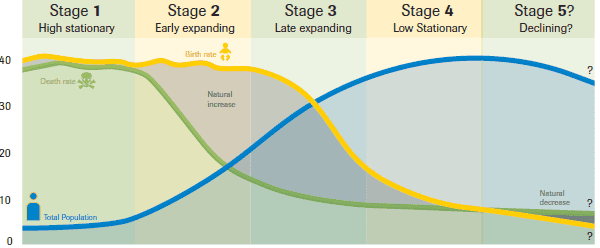
What is the Demographic Transition Model?
The Demographic Transition Model (DTM) is based on historical population trends of ii demographic characteristics – birth rate and decease rate – to suggest that a state'due south total population growth charge per unit cycles through stages as that state develops economically. Each stage is characterized past a specific relationship between nativity rate (number of almanac births per m people) and death rate (number of annual deaths per i m people). Equally these rates change in relation to each other, their produced impact greatly affects a land's full population. Within the model, a state will progress over fourth dimension from i phase to the next as certain social and economic forces act upon the birth and death rates. Every country can exist placed within the DTM, but non every stage of the model has a country that meets its specific definition. For example, at that place are currently no countries in Stage 1, nor are in that location any countries in Stage 5, but the potential is in that location for motion in the future.
What are the stages of the Demographic Transition Model?
In Stage one, which applied to near of the earth before the Industrial Revolution, both nativity rates and death rates are loftier. Every bit a upshot, population size remains fairly constant but can take major swings with events such as wars or pandemics.
In Stage 2, the introduction of modernistic medicine lowers death rates, specially among children, while birth rates remain high; the effect is rapid population growth. Many of the least developed countries today are in Stage 2.
In Phase 3, nascency rates gradually subtract, commonly equally a result of improved economical conditions, an increase in women'due south status, and access to contraception. Population growth continues, but at a lower rate. Most developing countries are in Stage 3.
In Stage iv, nativity and death rates are both low, stabilizing the population. These countries tend to have stronger economies, higher levels of education, meliorate healthcare, a higher proportion of working women, and a fertility charge per unit hovering around ii children per woman. Most developed countries are in Stage 4.
A possible Stage 5 would include countries in which fertility rates have fallen significantly below replacement level (ii children) and the elderly population is greater than the youthful population.
Limitations of the Demographic Transition Model
Like any model, there will be outliers and exceptions to the dominion and the Demographic Transition Model is no different. Additionally, there are limitations of the demographic transition model – things the DTM cannot reveal: the bear on of other demographic variables such as migration, are not considered, nor does the model predict how long a country volition exist in each phase. Merely even so, the relationship between birth charge per unit and expiry rate is an important concept when discussing population and whatever patterns, such as those provided by the DTM, that aid in understanding are helpful.
Demographic Transition Model Case Studies
Over a serial of five posts we volition explicate each stage of the Demographic Transition Model in depth and provide a case study for stages when in that location is a country that currently fits its parameters.
Demographic Transition Model blog series: Overview, Stage 1, Stage 2, Stage 3, Stage 4, Stage v
Nearly Population Teaching
Population Education provides K-12 teachers with innovative, easily-on lesson plans and professional development to teach about human population growth and its effects on the surround and human well-beingness. PopEd is a program of Population Connexion. Learn More than About PopEd.

What Is The Demographic Equation,
Source: https://populationeducation.org/what-demographic-transition-model/
Posted by: berniertheirm.blogspot.com
0 Response to "What Is The Demographic Equation"
Post a Comment